The Art of Gentle Weaning: Moving from Milk to Solids Smoothly
The day I offered my daughter her first spoonful of rice water, she looked at me like I had personally betrayed her. By week three, she was grabbing the spoon. Weaning is a journey, not a deadline.
Introduction
Weaning — the transition from exclusive milk feeding to including solid foods — is one of the most exciting and anxiety-producing milestones of the first year. When should you start? What should you offer? How do you handle refusal? What’s safe? This guide answers all of it, gently and practically.
When to Start: The Signs of Readiness
The WHO recommends exclusive breastfeeding for the first 6 months, with solid foods introduced from 6 months. But readiness isn’t just about age — it’s about developmental markers:
- Can sit up with minimal support and hold their head steady
- Shows interest in food — reaching toward your plate and watching you eat closely
- Has lost the tongue-thrust reflex (no longer automatically pushes food out)
- Can move food to the back of their mouth and swallow
Most babies show these signs between 5.5 and 7 months. Do not start before 4 months regardless of perceived readiness.
Approaches to Weaning
Traditional Spoon-Led Weaning (Purées)
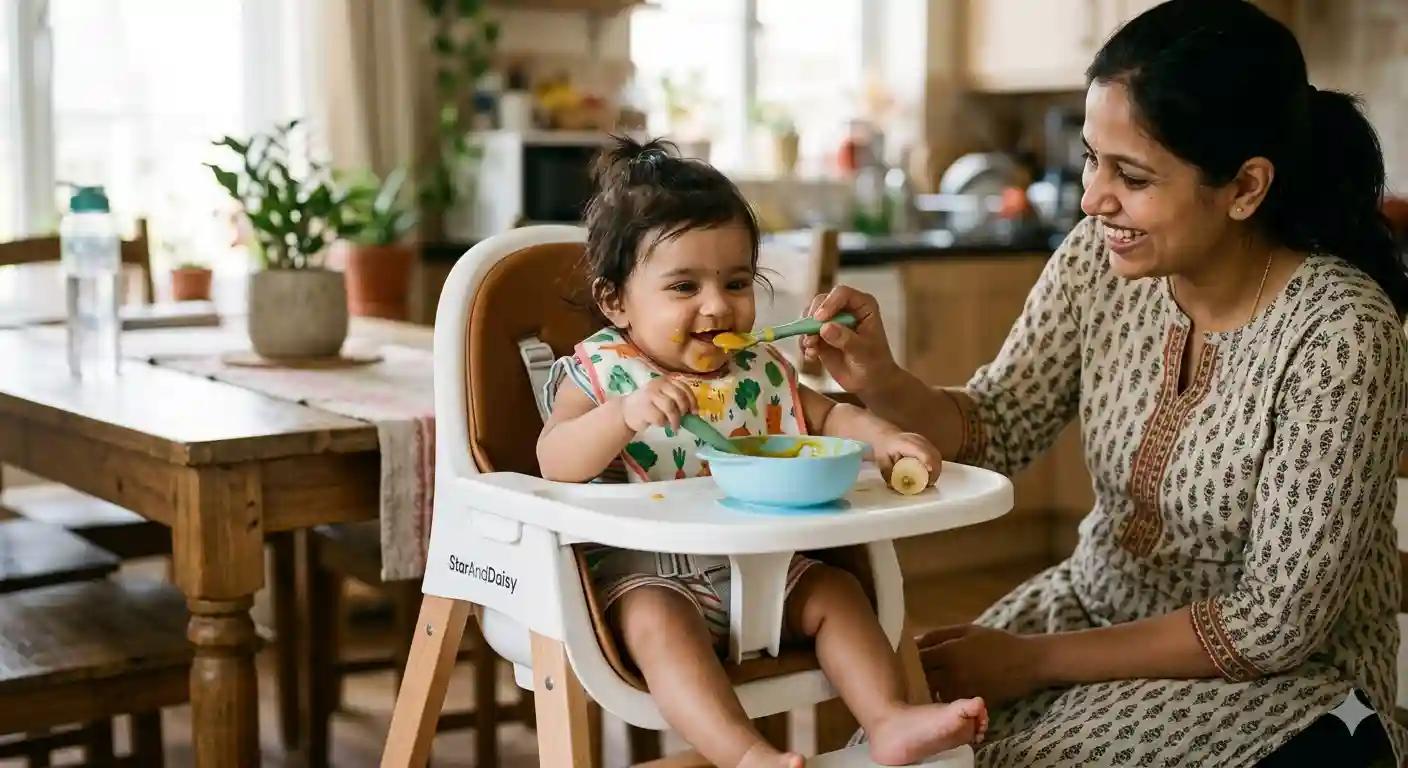
You prepare pureed or mashed foods and offer them by spoon. This allows precise control of texture, quantity, and nutrients. Very common in Indian households — starting with rice water, dal water, mashed banana, or fortified cereals.
Baby-Led Weaning (BLW)
Baby feeds themselves with soft, appropriately sized finger foods from the start — no purées. This method builds independence, self-regulation, and exposure to varied textures. It usually means more mess but less spoon-feeding stress.
Combination Approach (Most Popular)
Start with purées for confidence and control, then introduce finger foods progressively around 7–8 months. This is how most Indian families naturally wean.
First Foods for Indian Babies
- Month 6: Rice water (kanji), moong dal water, mashed banana, mashed avocado, sweet potato purée
- Month 7: Soft khichdi, apple purée, pear purée, carrot purée, vegetable mash
- Month 8: Finger foods like soft vegetable batons, banana pieces, toast strips, paneer cubes
- Month 9–12: Gradually introduce family foods with reduced salt and spice while encouraging self-feeding
Setting Up for Mealtime Success
The physical setup of mealtimes matters as much as what you offer. A baby who is uncomfortable, unsupported, or unable to engage with their food will often refuse to eat.
- A proper supportive high chair helps maintain safe upright positioning during meals
- A soft-tipped weaning spoon protects delicate gums
- A suction bowl helps prevent spills and food tossing
- A waterproof bib with a food pocket reduces cleanup stress
The StarAndDaisy High Chairs provide upright support, adjustable height settings, and easy-clean surfaces that make daily weaning routines far more manageable. The removable tray allows food to be offered directly on the tray for finger-food exploration or securely holds bowls during spoon feeding.
Handling Refusal: The Golden Rule
Follow the division of responsibility: You decide what and when to offer; your baby decides whether and how much to eat.
Never force, pressure, distract, or trick a baby into eating. A baby who is pressured during meals can become a toddler who strongly resists eating.
Offer food calmly, allow exploration, and move on without drama if they refuse.
It can take 10–15 or more exposures before a baby accepts a new food. Rejection today is not a permanent dislike.
Conclusion
Weaning is a slow, messy, beautiful journey. Some days your baby will eat enthusiastically. Other days they’ll blow raspberries at every spoonful. Both are completely normal.
During the first year, milk remains the primary source of nutrition. The real goal of solids is experience — textures, flavours, motor skills, and joyful family mealtimes.
Keep it low-pressure, keep it playful, and let your baby lead the pace.
Frequently Asked Questions
Dr. Vandana Raghav
Pediatrician & Child Health Expert
Hi, I’m Vandana Raghav, a pediatrician and child health expert associated with Mamaverse. My work is focused on helping parents better understand their child’s health, growth, development, nutrition, and overall well-being through reliable and practical guidance. As a pediatrician, I understand that parents often have questions and concerns at every stage of their child’s development. Through Mamaverse, I aim to make medically complex topics easier to understand while providing evidence-informed information that parents can use to have more informed conversations about their child’s care. My areas of interest include newborn care, infant health, child growth and development, nutrition, feeding, sleep, common childhood health concerns, preventive care, and overall child wellness. I believe trustworthy parenting and child-health information should be accurate, responsible, and easy to understand. My goal is to help Mamaverse provide parents with dependable health information while encouraging them to consult their pediatrician or other qualified healthcare professional whenever individualized medical assessment, diagnosis, or treatment is required. My Areas of Expertise: Pediatrics, Newborn Care, Infant Health, Child Health, Growth and Development, Child Nutrition, Preventive Care, Parenting and Child Wellness
Comments (0)
Leave a Comment
Related Articles
Baby Feeding Made Easy: How to Choose the Right High Chair for Your Baby
The first time I placed my baby in a high chair, it felt like a milestone—until the food started flying. Choosing the right high chair can make mealtimes safer, easier, and far less chaotic.

Healthy Diet Chart for Toddlers
Discover a nutritious diet chart tailored for toddlers that ensures balanced meals. Learn how to make mealtime enjoyable and healthy!

Best Baby Carriers in India 2026: Types, Safety & Buying Guide
A good baby carrier is your hands-free parenting superpower. But with so many types available in India, choosing the right one can be overwhelming. This guide makes it simple.

Signs Your Toddler May Have a Weak Immune System
Is your toddler frequently falling sick? Discover the signs of a weak immune system and how to strengthen their health naturally.